A systems-based governance framework designed to integrate leadership, quality improvement, compliance, operational excellence, and organizational learning into everyday healthcare practice.
© 2026 A3 Leadership Group. All Rights Reserved. Protected under copyright.
These four core dimensions represent the philosophical foundation of ICEF and guide how organizations approach sustainable improvement.
Many frameworks describe high-level philosophies, but few demonstrate how those values become operationalized in a complex continuing care environment.
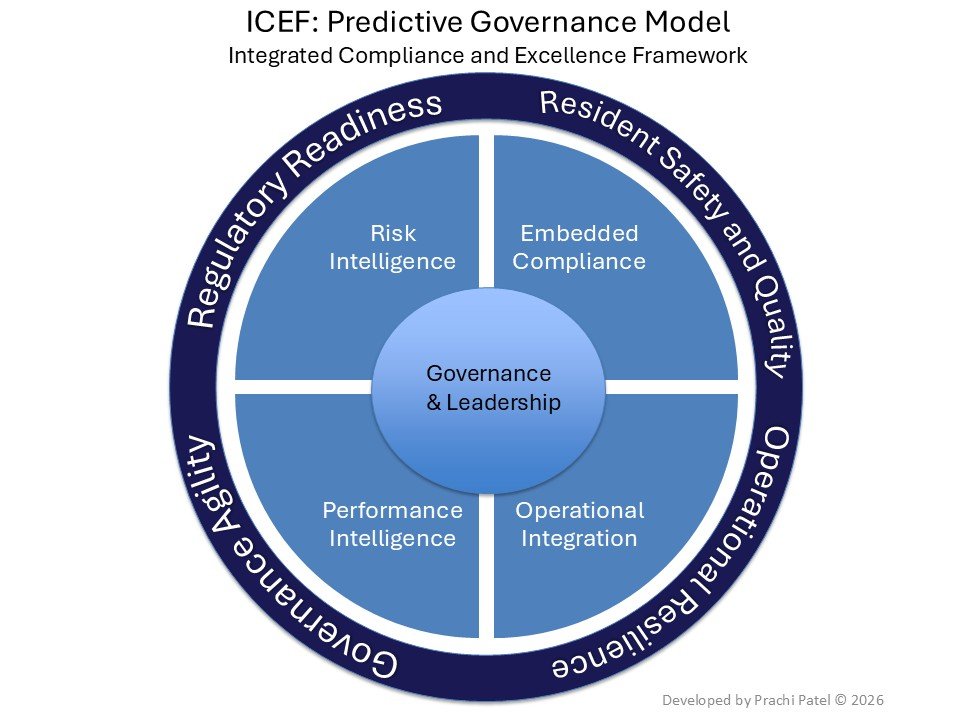
ICEF bridges this gap by translating philosophy into a concrete, interactive **Predictive Governance Model** that directs daily oversight.
ICEF bridges this gap by translating leadership philosophy into an integrated governance model that supports organizational decision-making, quality improvement, regulatory readiness, and long-term sustainability.
At the center of ICEF is Governance & Leadership. Surrounding this are 4 interconnected operational domains. Hover over each quadrant to explore details.
By operationalizing the ICEF domains, healthcare operators build structured resilience across all departments.
Supporting organizations in maintaining continuous preparedness and compliance safety rather than periodic crisis survey preparation.
Strengthening clinical systems, role designs, reporting guidelines, and workflows that support consistent, high-quality care.
Building governance structures capable of sustaining performance through organizational changes, workforce shifts, and leadership transitions.
Learn more about the Integrated Compliance and Excellence Framework (ICEF) and its application.
ICEF stands for the Integrated Compliance and Excellence Framework. It is a systems-based governance framework developed by A3 Leadership Group to integrate leadership, quality improvement, regulatory compliance, operational excellence, and organizational learning into one coordinated approach.
The framework is founded on four core principles—Insight, Culture, Execution, and Future—which provide the philosophical foundation for building sustainable organizational excellence. These principles are operationalized through the Predictive Governance Model, enabling healthcare organizations to strengthen accountability, improve decision-making, and embed continuous improvement into everyday practice.
Traditional compliance programs often focus on meeting regulatory requirements and preparing for scheduled inspections or accreditation reviews. While these activities are important, they can become reactive and episodic if they are not supported by strong governance systems.
ICEF takes a different approach by embedding compliance within everyday operations rather than treating it as a separate activity. It integrates governance, quality improvement, performance monitoring, leadership accountability, and organizational learning into one framework. The objective is not simply to achieve compliance but to build systems capable of sustaining quality, safety, and operational excellence over time.
Not exactly. ICEF is not intended to replace established quality improvement methodologies such as Lean, Six Sigma, Model for Improvement, or PDSA cycles. Instead, it provides the governance structure within which these methodologies can operate more effectively.
The framework helps organizations align quality improvement initiatives with leadership oversight, regulatory expectations, operational priorities, and organizational accountability. In this way, ICEF complements existing improvement approaches by creating an integrated system that supports implementation and long-term sustainability.
One of the key principles of ICEF is that organizations should strive for continuous readiness rather than periodic preparation. Rather than concentrating efforts immediately before an accreditation survey or regulatory inspection, ICEF supports the development of governance structures, accountability systems, performance monitoring, and operational processes that embed standards into routine practice.
By integrating quality, compliance, and leadership into everyday operations, organizations are better positioned to maintain ongoing readiness while reducing the disruption often associated with traditional survey preparation.
Explore how the ICEF methodology can help resolve recurring audit gaps, strengthen governance lines, and improve resident quality outcomes.